
Alberta Sector Profile: Transportation and Warehousing
Highlights
- There were 130,900 people employed in transportation and warehousing in Alberta in 2021, accounting for 6% of total provincial employment.
- Employment in transportation and warehousing in Alberta increased by 10,600 jobs (8.8%) from 2020 to 2021.
- Changing workforce demographics, new infrastructure projects, and labour shortages will create employment opportunities in transportation and warehousing from 2023 to 2024.
- Employment prospects will be moderate to strong across Alberta from 2023 to 2024 for most occupations in transportation and warehousing.
Provincial Overview
In 2021, there were 130,900 Albertans employed in the transportation and warehousing sector. The vast majority of those employed in the sector were employed in the transportation subsectors (121,400 workers, or 93.8%). In comparison, there were only about 9,500 people employed within the warehousing and storage subsector (6.2%). About 84.4% of the workforce in the transportation and warehousing sector worked full-time, while 15.6% of the workforce was employed on a part-time basis.

Source: Statistics Canada Labour Force Survey; Statistics Canada Table: 36-10-0402-01 (GDP at basic prices, chained 2012 dollars); Statistics Canada Table: 36-10-0400-01 (GDP at basic prices, current dollars)
In 2021, the sector contributed to:
Show graphic in plain text
While most workers in the sector are in the core working age group (25-54 years), about 24% of the workforce in the sector is aged 55 years and over. The rapidly ageing workforce, combined with high job vacancy rates, have contributed to acute labour shortages in many different subsectors within the transportation and warehousing sector.

Source: Statistics Canada Labour Force Survey, ESDC custom table
Of those employed in 2021:
Show graphic in plain text
Sector Trends
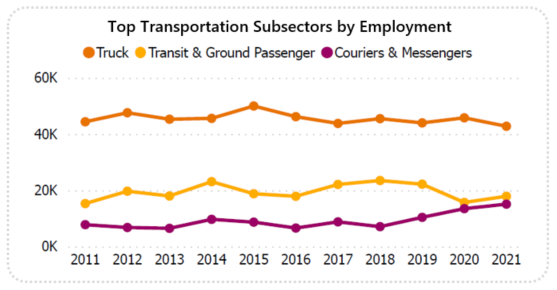
Among the subsectors, the truck transportation subsector had the highest job vacancy rate at 10.1% in Q2 2022, nearly double that of all other industries. While the issue of labour shortages in the truck transportation subsector has been exacerbated by the pandemic, this issue was prevalent in the sector prior to 2020. In fact, the truck transportation industry had the highest job vacancy rate across all industries in 2018, averaging 6.6%, nearly double the average rate for all other industries in Canada. [1] The provincial government has taken a number of measures, such as provincial grant programs, and subsidized training which are intended to recruit more truck drivers into the sector. [2] [3] The federal government has also recently included truck drivers in the Express Entry program, in the hopes of recruiting more international workers into the sector. [4] Continued labour shortages in the truck transportation subsector could negatively impact many other sectors, such as healthcare, oil and gas extraction, and retail shopping. The labour shortages in the sector may also fuel inflation, as the costs to transport goods across Canada increases. [5]
The air transportation subsector was severely impacted by the initial effects of COVID-19 pandemic related health restrictions. There were only 4,400 people employed in the subsector in July 2020, compared to 10,800 people in March 2020. As travel restrictions have been lifted, employment in the subsector has increased rapidly. In November 2022, 15,900 people were employed in the air transportation subsector in Alberta. The increase in employment has been supported by Alberta-based airlines such WestJet, Flair, and Lynx Air, which have expanded services, as travel restrictions have been gradually lifted. [6] [7] [8]

Source: Statistics Canada Labour Force Survey, ESDC custom table
Subsector Employment, 2021
Show graphic in plain text
Subsector
Employment
distribution
Transportation
93%
Warehousing and Storage
7%
The air transportation subsector is also dealing with acute labour shortages, which combined with poor weather conditions, have led to massive disruptions in holiday travel across Canada in December 2022. [9] Many Airlines are dealing with acute labour shortages in crucial occupations, such as pilots and air traffic controllers. [10] Airports across the province, specifically in Calgary and Edmonton, are also struggling to hire staff in order to accommodate high levels of travellers. [11] Employee recruitment and retention will be crucial to the air transportation subsector in Alberta.
Source: Statistics Canada Labour Force Survey, ESDC custom table
Top Transportation Subsectors by Employment
Note: Figures shown are employment estimates
Show graphic in plain text
Year
Truck
Transit &
Ground PassengerCouriers &
Messengers
2011
44,400
15,300
7,800
2012
47,600
19,700
6,800
2013
45,300
18,000
6,500
2014
45,600
23,100
9,700
2015
50,000
18,800
8,700
2016
46,200
17,900
6,600
2017
43,800
22,100
8,800
2018
45,500
23,500
7,100
2019
44,000
22,200
10,400
2020
45,800
15,700
13,500
2021
42,800
17,900
15,100
Employment Outlook
Employment prospects for transportation and warehousing are expected to be good in Alberta from 2023 to 2024. Changing workforce demographics, new infrastructure projects, and predicted labour shortages drive this outlook. Labour shortages are expected from 2023 to 2024 in some occupations in transportation and warehousing in Alberta due to Canada-wide shortages.
Population growth is expected to lead to new territorial transportation and warehousing jobs from 2023 to 2024. In the last three months of 2022, Alberta's population increased by 1.3%, the highest rate in the country. [12] This growth will create increased demand for transportation and warehousing workers to deliver goods and services to Alberta's population.
Infrastructure projects will create employment in transportation and warehousing in Alberta from 2023 to 2024. In late 2022, Amazon.com Inc. completed construction on its third fulfilment facility in Alberta: an automated warehouse in Parkland County, west of Edmonton [13] . Though this facility is fully automated, it is expected to hire 1,000 employees and contribute to demand for the transportation and warehousing sector in the province. Further, highway improvement projects such as the twinning of Highway 40 to Grande Prairie and upgrades to the ring roads around Edmonton and Calgary, as well as continued work on the Trans Mountain Pipeline Expansion, among other major energy and renewable projects, should contribute to employment in the sector.

Source: Statistics Canada Labour Force Survey, ESDC custom table
Transportation and Warehousing Employment
Note: Figures shown are employment estimates. Totals may not add to 100% due to rounding.
Show graphic in plain text
Year
Employment (Total)
Full-time
Part-time
2011
110,600
99,300
11,400
2012
117,600
105,400
12,200
2013
119,800
108,300
11,500
2014
127,400
113,700
13,700
2015
134,300
120,300
14,100
2016
125,900
111,800
14,100
2017
132,200
117,700
14,400
2018
134,200
116,900
17,300
2019
134,000
118,100
16,000
2020
120,200
105,500
14,700
2021
130,900
110,500
20,400
Occupation of Interest: Transport truck drivers (NOC 73300)
- Occupational Outlook: Employment prospects for transport truck drivers will be good in Alberta from 2023 to 2024.
- Duties: Include but are not limited to: operating trucks and maneuvering them in tight spaces, load trucks to maximize use of space and distribute weight, conduct security checks and inspections along the way; and follow local and inter-provincial highway safety regulations.
- Employment of transport truck drivers: 38,300 people were employed in this occupation in Alberta in 2021. [14]
- Education: Education requirements vary, but completion of secondary school is usually required, as well as completion of an accredited driver training course up to three months of duration and professional certification such as special drivers licensing requirements from the province.
- Wages: The median wage for transport truck drivers in 2022 was $28.00/hour in Alberta.
Further information on transport truck drivers and related occupations in Canada can be found here:

Source: Statistics Canada Labour Force Survey, ESDC custom table
Occupational Employment
Note: Figures shown are employment estimates
Show graphic in plain text
Year
Employment
2011
44,200
2012
43,700
2013
46,700
2014
45,700
2015
43,400
2016
45,100
2017
42,600
2018
44,100
2019
42,900
2020
39,200
2021
38,300
Endnotes
-
Statistics Canada (November 16, 2021) Canadian Occupational Projection System (COPS) Industrial Summary - Truck and Ground Passenger Transportation Services ↑
-
CBC News (September 20, 2022) Alberta's trucking industry continues to struggle with driver shortage ↑
-
Trucknews (November 27,2020) Alberta boosts access to trucking jobs ↑
-
CIC News (November 25, 2022) Truck drivers are now eligible for Express Entry ↑
-
TruckingHR Canada (November 2022) Labour Market Snapshot: November 2022 ↑
-
Financial Post (September 28, 2022) Flair Airlines boosting fleet in bid to grow capacity by 50% by next summer ↑
-
Lynx Air (September 28, 2022) Lynx Air announces major expansion to United States ↑
-
Calgary Herald (March 14, 2022) WestJet resumes more flights to Europe, sets plan to return to pre-pandemic levels ↑
-
CBC News (December 30, 2022) Lost luggage still clogs some Canadian airports after chaotic holiday travel week ↑
-
CTV News (October 28, 2022) Anticipate unavoidable flight disruptions as labour shortages persist, say experts ↑
-
Calgary Herald (August 23, 2022) Calgary airport gets $1.9M in federal funds to boost scheduling, connections ↑
-
Calgary Herald (December 21, 2022) A positive for the economy': Interprovincial migration continues to rise in Alberta. ↑
-
Government of Alberta. Amazon 'YEG2 Slingshot' Sortation Facility (Acheson) Accessed January 5, 2023. ↑
-
Statistics Canada (2022). 2021 Census of Population. ↑
Page details
- Date modified: