
Alberta Sector Profile: Educational Services
NAICS 61
- Workforce characteristics
- Main occupations
- Occupation of interest: Elementary school and kindergarten teachers (NOC 41221)
Highlights
- There were 168,100 people employed in educational services in Alberta in 2022, accounting for 7.1% of total provincial employment.
- Employment in the educational services sector increased slightly from 2021 to 2022.
- Population growth and a recent influx of residents due to high interprovincial migration will create employment opportunities in educational services from 2023 to 2024.
- Employment prospects will be moderate to strong across Alberta from 2023 to 2024 for most occupations in educational services.
About the Sector
Composition and importance of the sector
In 2022, 168,100 people were employed in the educational services sector. Within the educational services industry groups, about 98,400 people (58.5%) worked in primary and secondary education, 36,400 people (21.7%) worked in university education, 17,800 (10.6%) worked in other schools and educational support, and 12,200 (7.3%) worked in post-secondary education.

In 2022, the sector contributed to:
Source: Statistics Canada Labour Force Survey; Statistics Canada Table: 36-10-0402-01 (GDP at basic prices, chained 2012 dollars); Statistics Canada Table: 36-10-0400-01 (GDP at basic prices, current dollars)
Show graphic in plain text
Employment within the educational services accounted for 7.1% of total provincial employment in 2022. The sector also contributed $12.4 billion (4%) to the provincial GDP in 2021.
Geographical distribution of employment
The majority of employment in the educational services sector is concentrated in the two metropolitan centres of Alberta, Calgary and Edmonton. In Calgary, 67,000 people were employed in the sector, which accounted for 41.4% of the provincial total. In Edmonton, 52,500 people were employed in the sector, which accounted for 32.4% of the provincial total.
In comparison, the four other economic regions in the province (Red Deer, Camrose - Drumheller, Lethbridge - Medicine Hat, Banff - Jasper - Rocky Mountain House and Athabasca - Grand Prairie - Peace River) accounted for a total of 23.1% of the total provincial employment.
Workforce
Workforce characteristics
About 124,100 people (76.7%) were employed on a full-time basis, in the educational services sector, whereas about 37,600 people (23.2%) were employed on a part-time basis. The majority of workers in the educational services sector are female (69.5%).

Of those employed in 2022:
Source: Statistics Canada Labour Force Survey, ESDC custom table
Show graphic in plain text
About 72% of workers in the educational services sectors are core-aged workers (25-54 years). Although the majority of workers in the sector are in the core-age work group, about 21% of the sector is aged 55+ years. As these older workers continue to near retirement age, there will likely be many job vacancies in the sector. The global pandemic only served to exacerbate the issue. A November 2021 survey by the Alberta Teacher's Association found that 20% of respondents were unsure whether they will return for the 2022/2023 academic year. A further 10% stated they will not return for the 2022/2023 academic year. Most of these respondents who were planning or thinking of not returning were either retiring or leaving their profession for another occupation. [1]
Main occupations
The occupations in educational services in Alberta with the highest number of employees are, from highest to lowest, 41229 Secondary and elementary school teachers and educational counsellors not elsewhere classified, 41221 Elementary school and kindergarten teachers, 43100 Elementary and secondary school teacher assistants, 41201 Post-secondary teaching and research assistants, and 41210 College and other vocational instructors.
Occupation of interest: Elementary school and kindergarten teachers (NOC 41221)
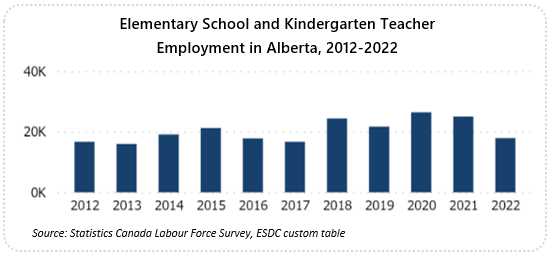
Elementary School and Kindergarten Teacher Employment in Alberta
Note: Figures shown are employment estimates
Source: Statistics Canada Labour Force Survey, ESDC custom table
Show graphic in plain text
Year
Employment
2012
16,700
2013
16,000
2014
19,100
2015
21,200
2016
17,800
2017
16,700
2018
24,400
2019
21,700
2020
26,400
2021
25,000
2022
17,900
- Occupational Outlook: Employment prospects for elementary school and kindergarten teachers will be good in Alberta from 2023 to 2024.
- Duties: Include but are not limited to: identify children's individual and collective learning needs for their age and grade, plan and deliver instruction based on student learning needs and approved curriculums, provide a stimulating learning environment in which each child can experience growth and develop to their potential using course material.
- Employment of elementary school and kindergarten teachers: 46,300 people were employed in this occupation in Alberta in 2021. [2]
- Education: In Alberta, the minimum qualification required to teach in an elementary school is 4 years of post-secondary education leading to a bachelor of education degree.
- Wages: The median wage for elementary school and kindergarten teachers in 2022 was $42.30/hour in Alberta.
Further information on elementary school teachers and related occupations in Canada can be found here:
- 41221 – Elementary School and kindergarten teachers
- Primary School Teacher in Alberta
- Primary School Teacher in Canada
Recent History
Employment in the educational services sector increased slightly from 2021 to 2022. Employment in the sector will need to increase in the short to medium term, especially as the population of Alberta continues to grow rapidly.
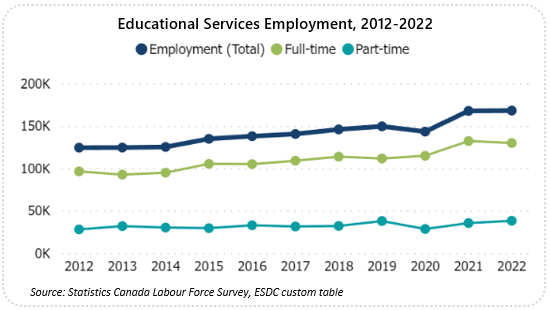
Educational Services Employment
Note: Figures shown are employment estimates. Totals may not add to 100% due to rounding.
Source: Statistics Canada Labour Force Survey, ESDC custom table
Show graphic in plain text
Year
Employment (Total)
Full-time
Part-time
2012
124,400
96,400
28,000
2013
124,500
92,600
31,900
2014
125,200
94,900
30,200
2015
134,800
105,300
29,500
2016
137,900
105,000
32,900
2017
140,500
109,000
31,500
2018
145,900
113,800
32,100
2019
149,500
111,600
37,900
2020
143,300
114,800
28,500
2021
167,700
132,200
35,500
2022
168,100
129,900
38,200
Much of this population growth has been concentrated in the metropolitan centres of Alberta, especially in the Calgary region. [3] This region gained about 25,622 immigrants in 2021-22. [4] Calgary is also a popular destination for international students. In 2021, there were about 32,600 international students studying in post-secondary institutions in Calgary. Many of these international students choose to remain in the province after graduation. [5] In total, the Calgary metropolitan area grew by 3.1% between July 1, 2021, and July 1, 2022. [6] This rapid population increase will require the educational services sector to grow in the short to medium term.
Alberta's significant population growth has prompted the provincial government to allocate substantial funding for the construction of new schools. The Budget 2023 Capital Plan provides $372 million for the design and construction of new schools. Project funding is included for the design of a new school in Glenridding Heights in Edmonton and construction of a replacement school in Valleyview. Other locations supported by this funding include Taber, Airdrie, Lethbridge, Red Earth Creek, Breton, and Calgary. [7] While educational services are expanding in the metropolitan centres, many rural areas in Alberta have struggled to fill vacant positions within this sector. [8]
In June 2022, the Alberta Teachers' Association members voted by a narrow margin to approve a mediator-recommended labour contract. The new contract includes a 0.5% increase effective on ratification, followed by a 1.25% wage increase in September 2022, and a 2.0% increase in September 2023. While this is positive news for the short term, a new round of collective bargaining will begin in 2024. [9]
The educational services sector faces a crucial area of concern regarding systemic barriers which impact educational outcomes for Indigenous children in the province. Annual education results reports, which include statistics from Alberta Education for 2021-22, show that more than 80% of Edmonton public school and Catholic school students finish high school on time. However, only 67% of students who self-identify as First Nations, Métis or Inuit (FNMI) finish high school on time in Edmonton Catholic schools and 47% of those in Edmonton public schools. The province-wide three-year high school completion rate for FNMI students was 60%. [10]
There is also an education gap between Indigenous and non-Indigenous populations in Alberta when it comes to post-secondary education. In October 2022, the Minister of Advanced Education announced the Alberta Government was investing $5 million over a three-year period into Indigenous education. The Province will spend $3.25 million to expand programs and create more spaces for Indigenous learners at First Nation colleges and public post-secondary institutions, and $1 million towards workforce development initiatives. The remaining $750,000 will go to Trade Winds to Success Training Society: an Indigenous-run group focusing on teaching Indigenous people skills for working in trades. This will help the society fund 40 extra students a year over the three-year period. [11]

Top Subsectors by Employment
Note: Figures shown are employment estimates
Source: Statistics Canada Labour Force Survey, ESDC custom table
Show graphic in plain text
Year
Elementary
& SecondaryUniversities
Other schools
& instruction
2012
73,400
27,600
9,300
2013
70,800
27,900
12,600
2014
74,400
28,000
10,800
2015
84,800
23,400
11,300
2016
81,900
29,700
13,100
2017
86,300
28,400
13,200
2018
92,300
29,000
11,100
2019
90,900
30,300
15,200
2020
86,800
28,000
14,600
2021
96,300
37,900
16,900
2022
98,400
36,400
17,800
Employment Outlook
Employment prospects for educational services are expected to be good in Alberta from 2023 to 2024. Population growth is expected drive this outlook, leading to new educational services jobs from 2023 to 2024. In the last three months of 2022, Alberta's population increased by 1.3%, the highest rate in the country. [12] As of 2022, Alberta had the youngest population in Canada among the provinces, with the lowest median age, and, along with Saskatchewan and Manitoba, had the highest proportion of children aged 8 or younger at 11%. [13]
Population growth will create increased demand for educational services to teach Alberta's school-age population, as well as drive demand for post-secondary and adult education from the influx of interprovincial and international migration. According to Conference Board of Canada data, Alberta retains the second-highest percentage of international students among all provinces and territories after three years. Alberta is also the second most popular destination province among international students who moved away from their initial province of study within the same timeframe. [14]
Endnotes
-
Alberta Teachers Association (November 19. 2021). Reporting on the Fourth Acute Wave of COVID-19 in Alberta K-12 Schools (Fall 2021). ↑
-
Statistics Canada (2022). 2021 Census of Population. ↑
-
ATB Financial (January 30, 2023). Population growth uneven across Alberta municipalities. ↑
-
Calgary Herald (January 18, 2023). Alberta to prioritize some immigrants based on immediate family connections. ↑
-
CIC News (January 27, 2023). Why Calgary is a premier destination for international students coming to Canada. ↑
-
Calgary Herald (Jan 12, 2023). More people are moving to Calgary area than anywhere else on Prairies. ↑
-
Government of Alberta (February 28, 2023). Budget 2023: Fiscal Plan Securing Alberta's Future 2023–26. ↑
-
Lakeland Today (September 1, 2022). Lakeland school divisions face challenges hiring teachers and support staff. ↑
-
Edmonton Journal (June 10, 2022). Alberta teachers to get 3.75 per cent wage hike between now and next fall. ↑
-
CBC News (January 25, 2023). Fewer than half of Indigenous students graduate on time from Edmonton public high schools. ↑
-
CochraneNow (October 3, 2022). Alberta Government investing in Indigenous education. ↑
-
Calgary Herald (December 21, 2022). A positive for the economy': Interprovincial migration continues to rise in Alberta. ↑
-
Business Council of Alberta (May 11, 2022). 2021 Census population trends: Population by age. ↑
-
CIC News (January 27, 2023). Why Calgary is a premier destination for international students coming to Canada. ↑
Page details
- Date modified: